
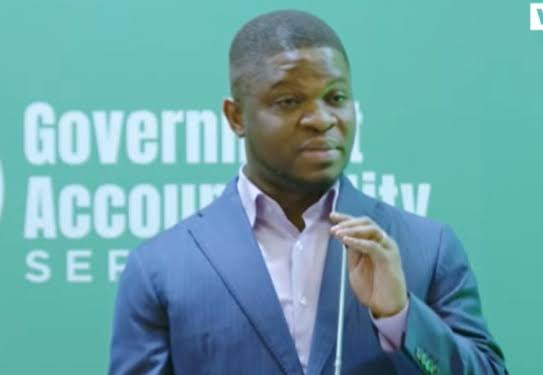
Ghana Gold Board (GoldBod) Chief Executive Officer Sammy Gyamfi has rejected claims that the International Monetary Fund (IMF) attributed the Bank of Ghana’s reported GH¢22 billion losses under the Domestic Gold Purchase Programme (DGPP) to GoldBod.
Mr Gyamfi said the IMF’s reports clearly identified the Bank of Ghana (BoG) as the institution that incurred the losses under the programme and did not accuse GoldBod of causing them.
His comments come amid growing controversy over the reported US$1.7 billion, equivalent to about GH¢22 billion, loss recorded under the DGPP in 2025.
The Minority in Parliament has accused GoldBod of effectively using the central bank as its “alter ego” and argued that the institution should be held responsible for the losses.
Speaking at the Government Accountability Series on Wednesday, August 19, Mr Gyamfi said the IMF report recorded losses of US$400 million incurred by the Bank of Ghana in 2024 and US$1.7 billion in 2025 through the Domestic Gold Purchase Programme.
According to him, the IMF attributed the 2025 losses to the scaling-up of the programme but did not identify GoldBod as the entity responsible for the losses.
He challenged Minority Leader Alexander Afenyo-Markin and other critics to produce evidence from the IMF report showing that the Fund had blamed GoldBod for the losses.
“Nowhere in the under-referenced IMF reports is GoldBod accused by the IMF as having caused the losses reported to have been incurred by the Bank of Ghana under the domestic gold purchase program,” Mr Gyamfi said.
He further challenged Mr Afenyo-Markin to identify the specific section of the IMF reports where GoldBod was named as the institution responsible for the losses.
Mr Gyamfi acknowledged that GoldBod was referenced in the IMF report in connection with fees paid to the institution under the Domestic Gold Purchase Programme.
However, he argued that the fees represented only one component of the overall losses incurred by the Bank of Ghana.
He therefore rejected attempts to equate GoldBod’s involvement in the programme with responsibility for the entire US$1.7 billion loss reported for 2025.
The GoldBod CEO said the distinction was important in understanding the financial implications of the DGPP and the role played by the different institutions involved.
Mr Gyamfi also cited the IMF report as stating that the Bank of Ghana, GoldBod and the government signed a Memorandum of Understanding (MoU) in July 2026.
The agreement, he said, formalised the transfer of Domestic Gold Purchase Programme activities from the central bank to GoldBod.
According to Mr Gyamfi, the arrangement was designed to remove the related quasi-fiscal risks from the Bank of Ghana.
The transfer means GoldBod is now positioned to take on a greater role in managing the government’s domestic gold purchasing operations, while the central bank is expected to be shielded from the fiscal risks associated with the programme.


 Chief Executive Officer Sammy Gyamfi has rejected claims that the International Monetary Fund (IMF) attributed the Bank of Ghana)